A file to open.
Not a question to answer.
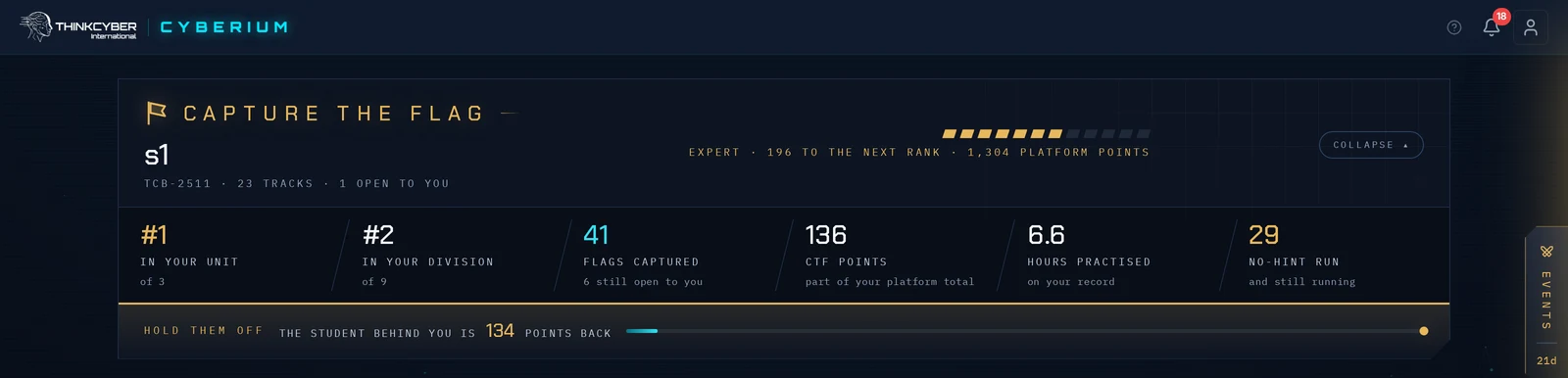
Every Capture the Flag challenge hands the student something real to work on — a config, a capture, a log — which they download, open, and are graded on what they get out of it. Nothing is multiple choice. It runs beside the taught programs, timed and scored, for the five days a week the trainer is not in the room.
Three sample challenges, playable here. In the platform a student downloads the artifact and works it in their own terminal.
The hard part of a course is not
the hours you teach.
It is the other five days. A student who does nothing between Tuesday and the following Tuesday arrives having forgotten the lab, and the trainer spends the first hour recovering ground. Capture the Flag is what a student does in that gap, without a trainer present and without anyone having to set it.
Evidence, then an answer
the student had to find.
A challenge is not a question with four options underneath it. It is an artifact and a task.
Foundations, defence, offence.
Challenge tracks follow the program catalog, so what a student practises in their own time is the same material they are taught — not a separate puzzle collection bolted on beside it.
Something to sell that
does not cost you hours.
Every hour of teaching a training company sells has a trainer standing in a room behind it. Capture the Flag does not. It runs on its own, it keeps students engaged between the sessions you are paid for, and it gives you something to show a corporate client that a slide deck cannot: their own people, ranked, with a record of what they actually did.
Browse the program catalog.
a full catalogue of programs across seven levels — choose by audience, role, or specialization to see exactly what a student covers.